Read the first paragraph of almost any web page and you often know by the end of the second sentence that nobody sat down and wrote it. The opening circles the question you asked. Three points follow, each one correct-sounding. The close summarises what was just said. There is no person in it, no number, not one thing that actually happened.
That thing has a name now: AI slop. This article answers three questions. What does the word actually mean? Why is there so much of it? And how is work made with AI different? We use AI every day ourselves, and we do not want the two treated as one thing.
Where the word comes from
Slop is an old word. In the 1700s it meant soft mud, and it slowly spread to mean something of little value, as Merriam-Webster tells it.
The sense we mean spread after 8 May 2024, when Simon Willison wrote that just as “spam” names email nobody asked for, we need a name for AI-generated content that gets passed to readers without anyone checking it, and “slop” fits. He was not the first to use it, but that post turned it into the word people picked up.
By the end of 2025 two dictionaries had made it official. Macquarie Dictionary chose “AI slop” as its word of the year. Merriam-Webster chose “slop”, defining it as low-quality digital content, usually produced in quantity by AI. Macquarie’s definition adds two things worth noticing: it often contains errors, and the user did not ask for it.
Two questions that separate slop from work made with AI
The dictionaries talk about quality, but quality is hard to measure. A more useful definition is the one Willison keeps on his tag page: AI content that is unrequested and unreviewed. It turns into two questions.
Did anyone ask for it? The reader came to this page wanting an answer about something. Does what they found answer it, or is it there because a page has to have content?
Did anyone read it before it went out? Before it reached the reader, did someone accountable read every sentence and decide what stays and what goes?
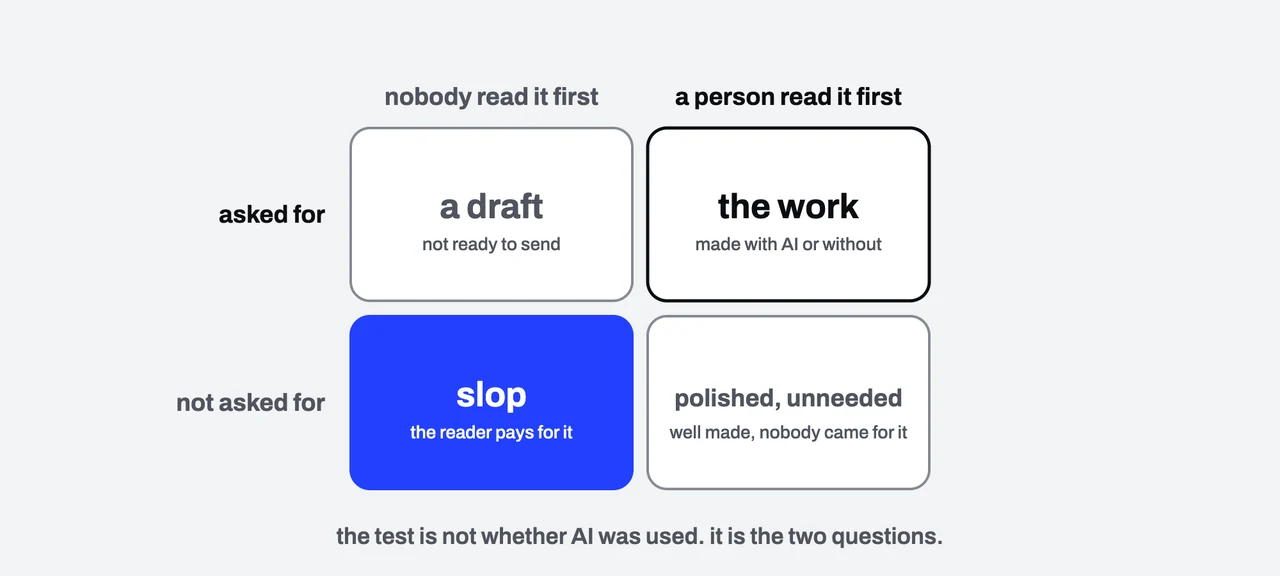
If both answers are no, it is slop. If both are yes, then even if AI wrote the first draft, it is work that passed through a person’s hands. The other two cells are not a way out. A draft someone asked for but nobody has read is a draft, not something to send. And a thing a person polished that nobody needed is still not good work.
Note that the test does not ask whether AI was used. A person can produce this too: a paragraph written to hit a word count can be slop. The difference is that AI makes it unlimited and nearly effortless.
Why there is so much of it
Because the cost is lopsided. Making a page used to take a person’s time. Now it takes seconds. The cost of reading did not fall with it. The reader still spends the same time finding out that a page has nothing for them.
So the cost moves from the sender to the receiver. One person presses a button and gets ten pages. Everyone else reads all ten to learn that none of them says anything. That is the same structure as junk email.
Readers learn quickly. After three pages that read as empty, they stop giving the fourth a chance. That is the price a brand pays: when its own site looks like slop, nobody spends time working out that this one is different.
What slop looks like
There is no list that stays true, because models change faster than anyone can catalogue them. But three groups keep showing up, and we can say why they fail.
Text
An opening paragraph that repeats the topic and says it matters. The reader already knows the topic, so the sentence gives them nothing.
Claims nobody could be wrong about, such as “quality is what matters”. A sentence that cannot be wrong usually says nothing, because it suits every business.
Everything in threes, each given the same weight. Real content rarely splits into three equal parts.
No names, no places, no numbers, no events. Nothing that can be checked.
Pictures
Every picture is pretty, none of them about what the page says. They are there because that spot needed a picture.
A set whose light, style and characters do not carry from one to the next, because each was ordered separately and nobody directed the whole.
Websites
Cover the logo and you cannot say whose site it is. We wrote a separate piece on how to check this: a template site and a designed site.
Motion added because it looks advanced, not because it has a job, while the site gets slower for no reason.
The swap test
The quickest check we know is to swap the name. Take the paragraph you doubt and put a competitor’s name where the brand’s was. If every word still works, the paragraph is not about anyone.
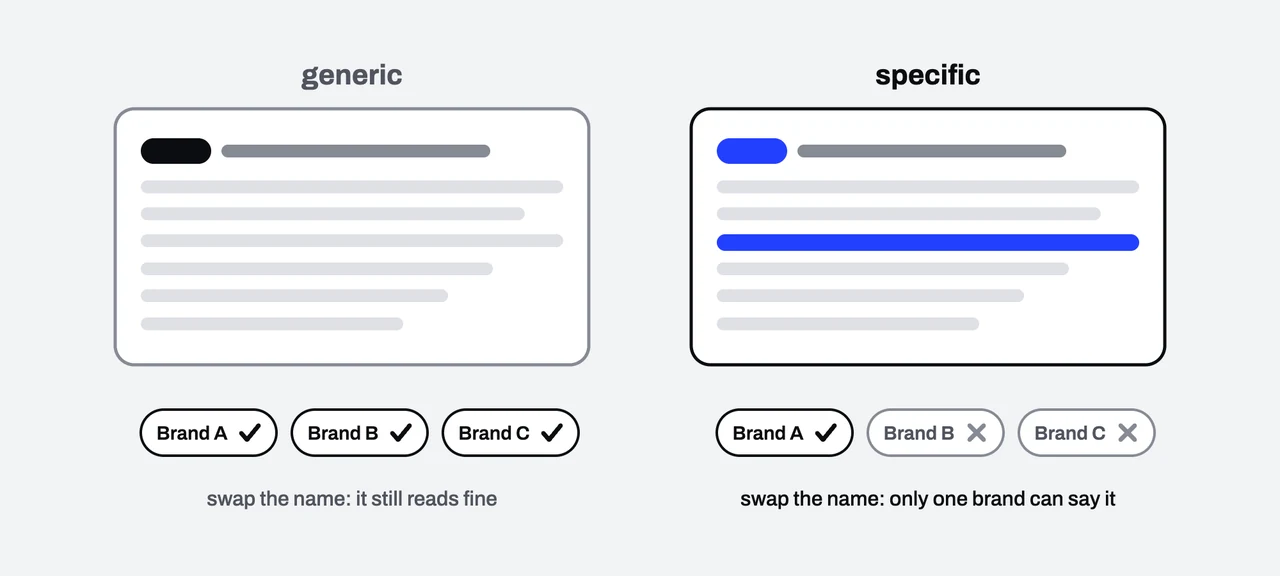
A sentence that passes is specific enough that nobody else could use it: a client’s name, something that really happened, a number with a source, or a decision where someone admits they chose A over B. The last one matters most, because slop refuses to choose. It says everything at once so that none of it can be wrong.
So how is work made with AI different?
We use Claude Code and Codex to write code, Codex to make stills, and Higgsfield for looping video. We do not hide it, and we do not think AI is the problem. The problem is releasing the output with nobody having made a single decision about it.
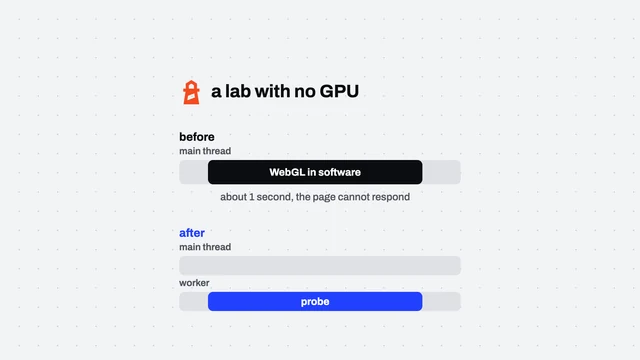
In our work the difference is who chooses. AI proposes fast and proposes a lot, which is useful. But deciding what goes in and what comes out, which picture belongs to the set, which sentence only this brand can say, and when to stop editing is a designer’s job. One example we wrote up in detail is the 3D page whose PageSpeed score dropped, where we show how we found the cause, step by step.
The line we use for ourselves is designed by people, not AI slop. It does not mean no AI. It means a person is responsible for everything that reaches the reader.
Five checks for your own work
They work on text an AI drafted for you, or on a site someone sends you to look at.
Who is the reader, and what did they come for? If you cannot say it in one sentence, do not start writing yet.
Does it still work with the name swapped? If it does, find a sentence only this brand can say and put it in.
Can every claim be checked? A name, a number, a date, or a link the reader can open. Anything that cannot be checked, cut it or shrink it until it can.
Read it aloud. A sentence you would not want to say to someone’s face is one the reader will not want to read.
Delete one paragraph at a time. If the piece loses nothing, that paragraph was only filling space.
If your own site has pages that fail some of these, or you want to start fresh so it does not, tell us your brief. How we work and what it costs are in the FAQ, and examples are in the work.